The Challenge
Imagine four sprinters are competing in an Olympic 100-meter semifinal for a place in the final. Based only on each athlete's profile below, predict how they will finish.
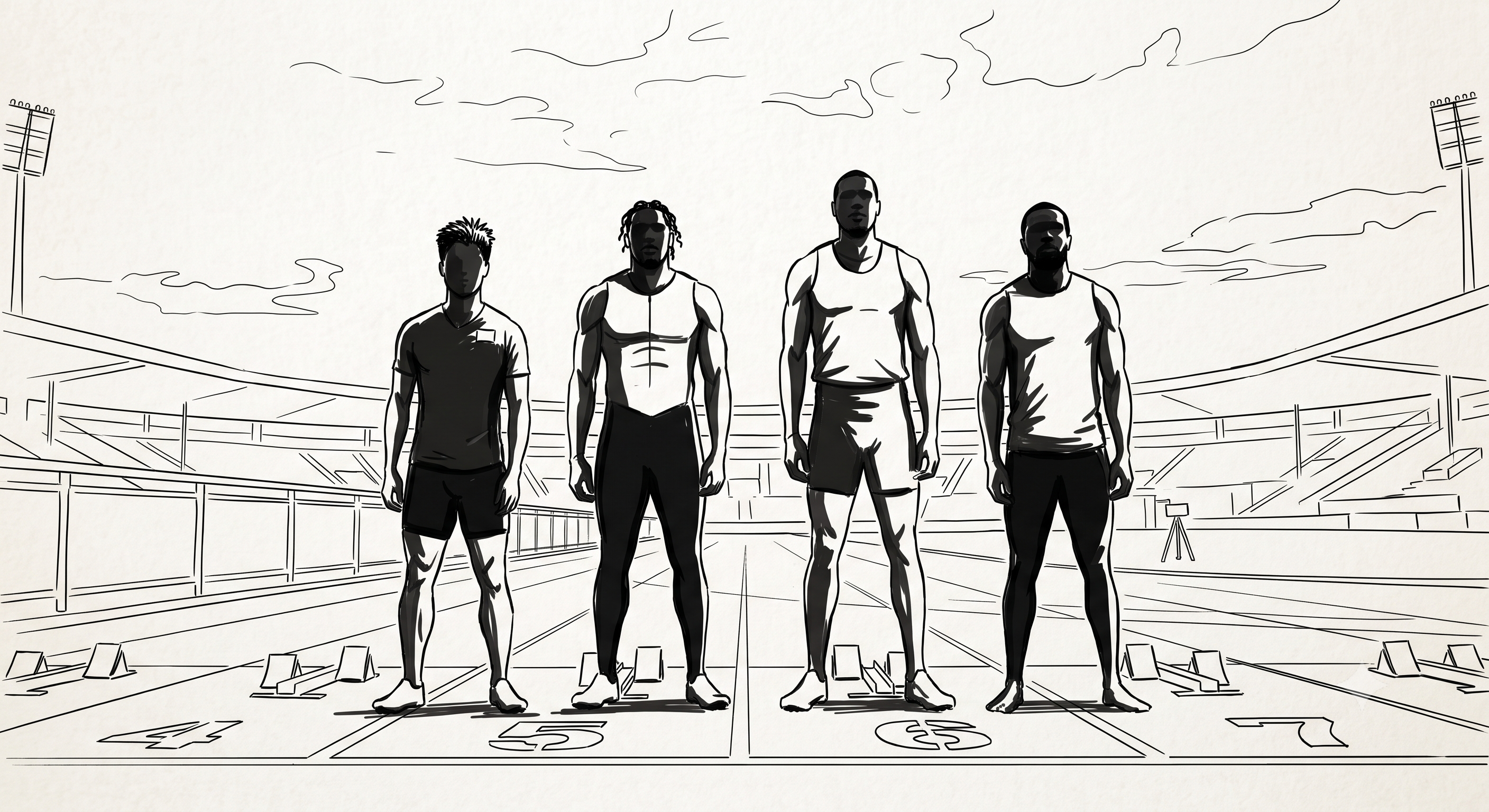
| Athlete | Country | Age (Aug 2021) | Height & Weight | Body profile |
|---|---|---|---|---|
| A | Italy | 26 | 186 cm (6'1") / 84 kg | Tall, powerful frame; long stride; explosive acceleration |
| B | United States | 27 | 178 cm (5'10") / 77 kg | Strong, balanced sprinter build; high top speed profile |
| C | China | 31 | 173 cm (5'8") / 70 kg | Compact frame; shorter legs; exceptional acceleration and technical efficiency |
| D | South Africa | 27 | 176 cm (5'9") / 74 kg | Slightly shorter than many finalists; exceptional mechanics and consistency |
Average height of elite international sprinters: approximately 180 cm.
Historical Olympic 100m dominance
| Country | Gold | Silver | Bronze | Total | % of Total |
|---|---|---|---|---|---|
| United States | 18 | 16 | 10 | 44 | 47% |
| Jamaica | 3 | 5 | 1 | 9 | 10% |
| Great Britain | 3 | 2 | 3 | 8 | 9% |
| Canada | 2 | 0 | 5 | 7 | 7% |
| Trinidad and Tobago | 1 | 2 | 1 | 4 | 4% |
| Germany | 1 | 1 | 2 | 4 | 4% |
| Australia | 0 | 0 | 3 | 3 | 3% |
| Soviet Union | 1 | 0 | 1 | 2 | 2% |
| Cuba | 0 | 2 | 0 | 2 | 2% |
| Namibia | 0 | 2 | 0 | 2 | 2% |
Source: Olympedia men's 100m Olympic event history.
Rank the athletes fastest to slowest
Move each athlete up or down to place them in order.
What information did you rely on?
Saved on this device. Only you can see this.
What did you assume?
The Stage
When's the last time someone told you it wasn't possible? Was it from a teacher, a friend, or a failed project that didn't need words? Or was it you telling yourself?
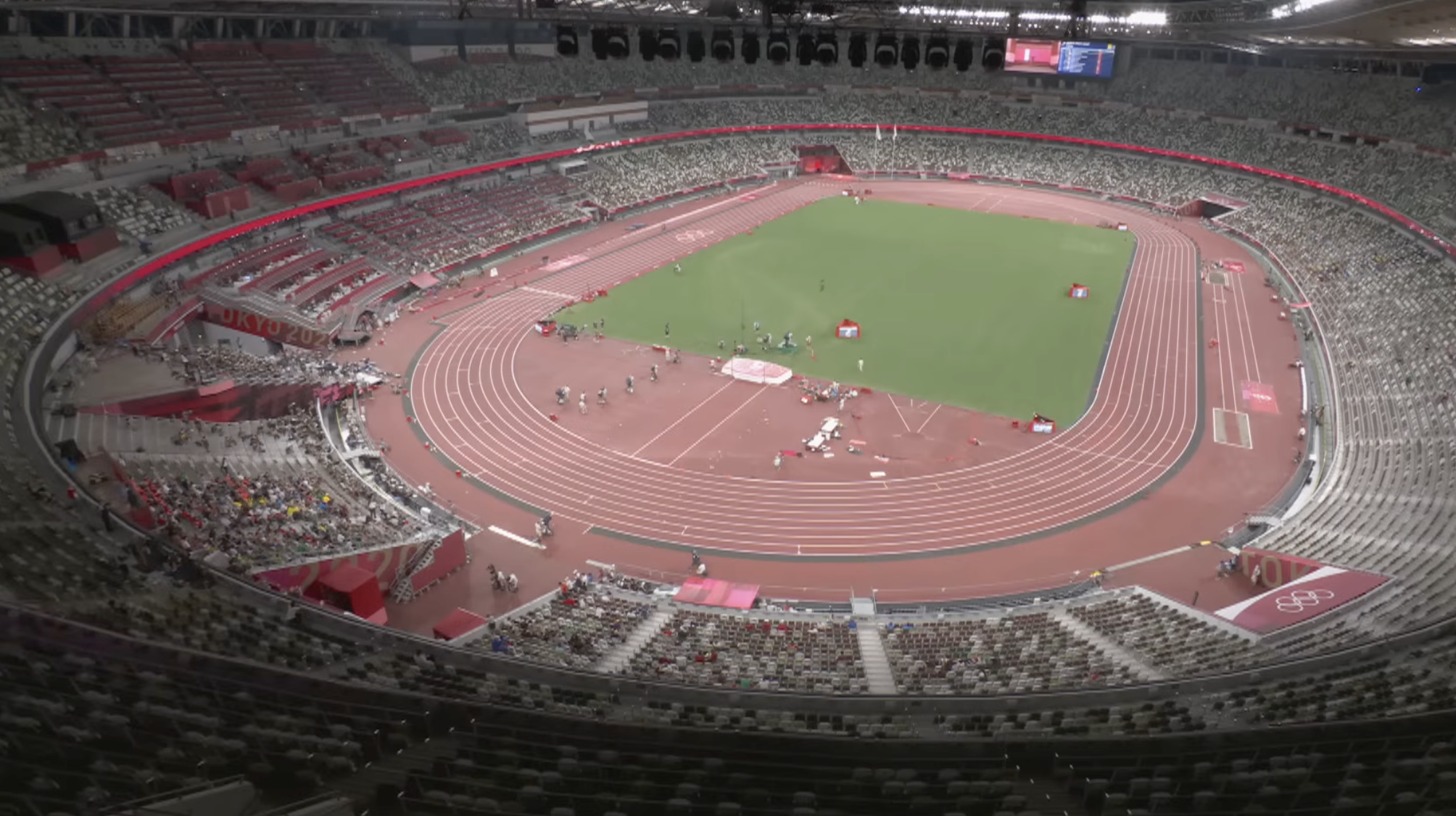
The Tokyo 2020 Games departed from the usual script. For the first time in Olympic history, the Games did not take place in the year they were scheduled. Delayed by the COVID-19 pandemic, they were held in the summer of 2021. One year after the event had been postponed, Japan remained under a state of emergency, and the 68,000-seat Olympic Stadium stood almost empty without spectators. Instead, recorded crowd noise echoed through the venue, recreating the atmosphere in which the world's best athletes were accustomed to competing.
And that wasn't the only script that got rewritten.
In lane four of the third men's 100-meter semifinal heat was China's Su Bingtian. Up to that point, only one Asian man, Japan's Takayoshi Yoshioka in 1932, had ever qualified for the 100-meter finals in the Games' 125-year history. None had done so in the fully automatic timing era that began at the 1964 Tokyo Games.
For decades, many coaches and biomechanists believed it was highly unlikely for an Asian-born sprinter to compete with the world's fastest men. Elite sprinters were typically taller, with longer legs and greater stride lengths. Su had a longer torso and shorter legs, a proportion common among East Asians. He was five-foot-eight and noticeably smaller in stature than most Olympic finalists. As he approached thirty-two years old, he was also well beyond the age at which most elite sprinters reach their peak.
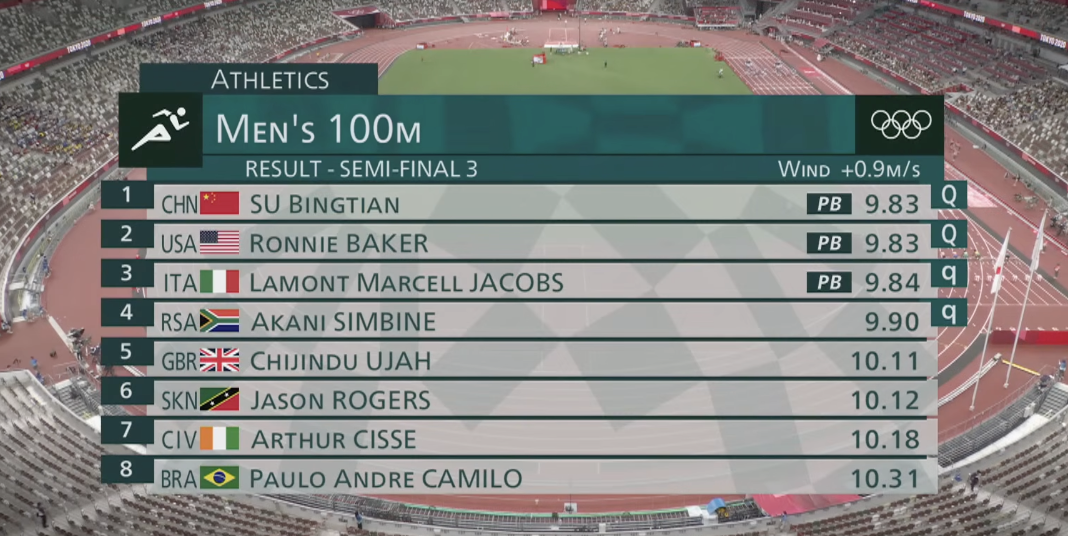
Su faced multiple gold-medal contenders in his heat. Ronnie Baker placed second at the US Olympic Trials and held a personal best of 9.85 seconds. Akani Simbine, the record holder for Africa, owned a personal best of 9.84. Marcell Jacobs from Italy, who would win the race at 9.80, was in the same heat. Su's opponents could run at or below 9.85 seconds, a threshold that felt impossible for Asian men to reach.
Standing on the Olympic track in Tokyo, Su was in a very different place than he had been nearly a decade earlier.
The Rebuild
In 2012, Su arrived in London alone for his Olympic debut. Lined up beside him in the semifinal was the world's fastest man and defending champion from Jamaica, Usain Bolt. That day, Su exploded out of the blocks in lane three, surpassing everyone for the first 20 meters before all his opponents sped past him. He crossed the finish line in 10.28 seconds, last in his heat, while Bolt cruised to first in 9.87. That blink-of-an-eye difference in time represented a massive difference in elite sprinting. For Asian male sprinters, the 10-second time barrier felt like an unbreakable spell.
Su realized it was pointless to keep running the same way if he was to hover at the 10-second mark. Seeking a breakthrough, he made the radical decision to rebuild his start, switching from pushing off the blocks with his right foot to his left. It was a dramatic and risky move that others tried to dissuade him from, especially since his explosive start was already his leading strength. This seemingly small adjustment required him to dismantle years of ingrained muscle memory to relearn every phase of his sprint mechanics. During the grueling transition, his performance suffered so drastically that he was embarrassed by falling behind the elite female sprinters.
His persistence and willingness to gamble paid off in 2015. At the Prefontaine Classic in Eugene, Oregon, Su clocked a new personal best of 9.99 seconds, becoming the first Asian-born sprinter to legally break the 10-second barrier.
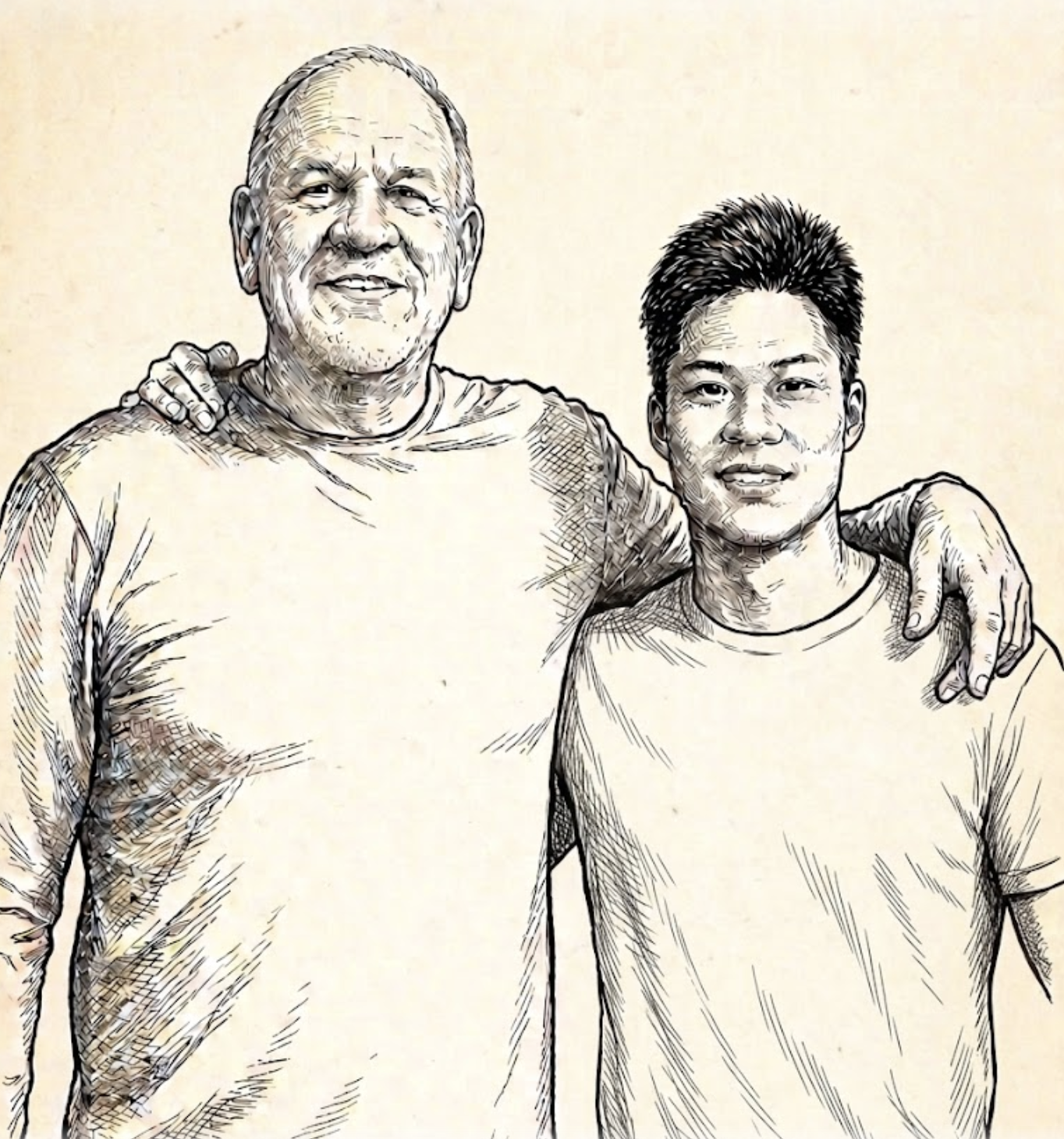
Two years later, in 2017, veteran American sprints and jumps coach Randy Huntington, who had first identified a problem with Su's starting foot during their work together in 2014, became Su's primary sprint coach. At the time, Huntington was already working with the Chinese national team, and he noticed something others had overlooked. He believed Su had the potential to run under 9.90 seconds, perhaps even 9.85. When Huntington shared his assessment with members of Su's team and athletic administrators, they responded with laughter. The script about Asian sprinters was so entrenched that no one believed it was possible, not even Su initially.
At that time, in 2017, when I wanted to retire, I felt that at this age, at the age of 27 or 28, I should not be able to make myself. I have continued to improve in performance, and there is no way to achieve some breakthroughs.
Huntington's confidence wasn't based on optimism. It was grounded in biomechanics, exercise physiology, strength training, and decades of coaching elite track athletes to which the Chinese team had never been fully exposed. The Chinese sprinters were primarily influenced by the Japanese coaching models, which placed greater emphasis on stride frequency to generate speed. Huntington shifted the focus toward maximizing ground force production, acceleration, and stride length and personalized his training based on Su's physique.
While Su had been known for his explosive starts, Huntington saw that Su lacked the technical mechanics and was weak in his strength. The team was hesitant about Huntington's methods at first, as they weren't always intuitive, such as slowing down frequency, something they had always attributed to speed, for stride length. They would tell him he was using the American way and that they had their own style, until they began to see how Su could be reengineered using proven data and the mechanics of the world's fastest sprinters.
Huntington was focused on utilizing science, technology, and data to find the optimal combination of muscle and leg movements that could support Su to run at his best. He was measuring things that the Chinese team was not measuring to gain the insights needed to adjust and optimize Su's performance.
By 2018, Su had reached 9.91 seconds, just one-hundredth of a second shy of Huntington's original prediction. Beyond the numbers, the improvements gave Su the confidence to pursue his goal of 9.85 and to qualify for the 100-meter Olympic finals.
The Race
Now, standing on the Olympic track in Tokyo, everything came down to a race lasting less than ten seconds. As the starter's pistol fired, Su launched off the blocks with a lead. Unlike his first Olympic race, however, he held on to his position well past the 20-meter mark. He sprinted with greater strength, fast strides, and higher maximum velocity, allowing him to maintain his lead even as others closed in on him in the final few meters. He crossed the finish line first in 9.83 seconds, becoming the first Asian-born sprinter to qualify for the Olympic men's 100-meter final in the fully automated timing era, in Tokyo, where digital timing was first introduced. He also achieved a speed that few thought possible, registering one of the fastest semifinal performances in Olympic track history.
- Head back to Card 1 to rank the athletes first.
In an interview, Huntington shared that Su still had more in him if he could just learn to relax, as he was visibly tensing up in his final meters. It would have helped him eliminate unnecessary tension at maximum velocity, a hallmark of the world's fastest sprinters. Had Su mastered that ability, Huntington believed he could theoretically approach 9.78, a limit he held for Su.
Looking back, Su credits more than training for his success. He believes it required faith in himself, a sense of purpose, and support that he didn't always have. As a fifteen-year-old boy from Guangdong Province, he had been invited onto the school track team after a teacher noticed how he could leap across a sandbox untrained. He enjoyed the attention that came with being the fastest, but the relentless training often left him questioning why he was doing it at all. As he continued his races onto bigger stages, he realized the impact an athlete could have, and that's when his efforts took on meaning. That sense of purpose carried him toward a level and an audience he had never imagined existed. He could not have dreamt the possibility until it revealed itself.
For Su, an improvement of just a few hundredths of a second represented nearly a decade of rebuilding his technique, challenging conventional wisdom, and persisting on a possibility that almost no one could foresee, because it was never part of the original script, until a new one was written. He didn't defy human biology; instead, he had a team who knew how to move past the standard script and optimize his potential using science and technology.
About Su
A false negative often tells us more about the limits of our script than the limits of reality. When our scripts narrow what we think is possible, they can cause us to overlook real possibilities that are right in front of us.
Unlike false positives, false negatives are especially hard to notice because the possibility is often dismissed before it ever has a chance to prove itself. If we never expect something to be possible, we may never look for it, test it, or give it a chance. The missing evidence then reinforces the original belief. That is, until someone like Su Bingtian breaks the pattern. By doing what others thought couldn't be done, he doesn't just change the result, he rewrites the script to enable others to see what is possible.
-
ChallengeEvery breakthrough reveals a first principle of becoming: a fundamental truth about how people grow into more of their potential. Su's story surfaces at least three. Name one you noticed most, then see how it compares to our top three.
The first principle of becoming I learned from Su's story is that This is easy to miss because If I were teaching this lesson to someone else, I would say:
Our top three first principlesDid any land close to what you noticed?
-
1. Measure what matters, not just what has already been measured.
We can only reach our potential when we measure what truly matters, rather than relying on standards that define what is already known or what has already been achieved.
Why it matters
The metrics we choose shape the possibilities we see. A measurement system built from past outcomes can unintentionally become a ceiling for future potential.
-
2. Potential requires the right ecosystem to flourish.
Talent alone is not enough. Extraordinary potential emerges when talent is supported by the right ecosystem, resources, relationships, and opportunities.
Why it matters
Contrary to the stories people like to tell, greatness is rarely achieved through individual effort alone. The right environment and support reveals and develops capabilities that might otherwise remain hidden.
-
3. Hold your scripts loosely.
Scripts help us navigate the world, but when we mistake them for reality, they can limit what we believe is possible. Becoming our best selves begins by questioning the assumptions that shape how we see ourselves, others, and the world around us.
Why it matters
What gets us here is often what keeps us from moving forward. What once helped us succeed can become the obstacle preventing our next stage of growth.
Saved on this device. Only you can see this.
-
About You
Two young fish are swimming along when they encounter an older fish swimming the other way. The older fish says, "Morning, boys. How's the water?"
The two young fish swim on for a while. Eventually, one turns to the other and asks, "What the heck is water?"
Like a fish unaware of the water it swims in, we cannot break the barriers we cannot see. The first breakthrough is feeling the water, identifying what is shaping you, and defining what you believe is possible. Once those scripts are revealed, they become visible and testable. Su would not be the exception as you start to look across fields and patterns of how people exceeded limits of prevailing script, often dressed as settled fact, had been declared impossible.
-
Can you name common societal scripts or beliefs, ones that people repeat but no one questions?
Saved on this device. Only you can see this.
-
How do you see the script show up in your own life?
Surfacing the script for self. Fill in any that resonate.
Growing up, I learned that people who are should
The kind of person I admire is someone who
If I tried to people would probably
-
What does the script measure? Where does it serve you, and how could it hold you back?
The script measures and it serves me when and it holds me back when
-
Are there false negatives, examples of when someone followed a different script and achieved the same success?
followed a different script by and the result was
-
What is one small step you can try to break a limiting barrier that might be holding you back?
This week, I will instead of to see
Case Closed
Congratulations!
You completed your first case.
Your sense of self is neither discovered nor invented in isolation.
Scripts shape what we value. What we value guides what we measure. What we measure drives our behaviors and our attention. Our behaviors and attention shape our sense of self and our perception of reality. Our perception reinforces the script until reality reveals its limits.
Are you the author of your script, or is the script writing you?
Watch the Moments
The two races that bookend Su's rewrite of the script.